

About the Program
Roam Dog Training offers service dog coaching to disabled individuals who wish to train their own service dog. Designed for the eager and dedicated owner-trainer, Roam’s service dog program is thorough and rigorous, offering a personalized and flexible training structure. Adrian trained their own service dog under the mentorship of a Guide Dog Mobility Instructor and has spent years coaching service dog owner-trainers in private, group, and online settings. Please note that no photos of service dog clients are shown on this website.
Handler Requirements
-
Diagnosed with a disability
-
Has, or is in the process of obtaining, a letter from a healthcare practitioner confirming the handler's disability and need for a service dog
-
Has supports and/or treatments to help with their disability in addition to the service dog
-
Can afford to pay for the required training
-
Can ensure the service dog will be exercised, fed, groomed, and vetted appropriately
-
Can regularly leave the home to train in different locations, attend all training sessions, and do all assigned homework
-
18 years of age or older
Service Dog Requirements
*These requirements may not all apply to young puppies
-
Food motivated
-
Well socialized and comfortable in a variety of urban environments
-
Neutral to dogs, people, and noises
-
Physically fit and able to walk for extended periods of time in all weather conditions
-
Well-exercised and enriched outside of service dog training
-
Does not mind slightly boring training and settling daily
-
Must be an appropriate size and breed for the service work required
Tasks Trained
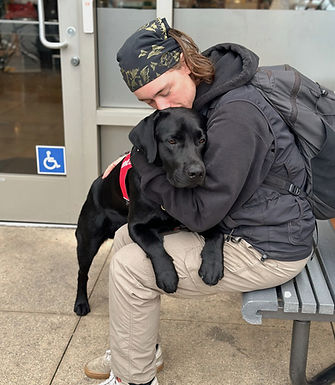


Individuals with a range of different disabilities may benefit from the following tasks. Most tasks are not specific to one disability.
Medical Alert: Service dog alerts the handler to an oncoming medical episode or to the presence of an episode’s trigger. Alerts can be scent- or non-scent-based. Examples include: panic attack alert, cardiac alert, blood sugar alert, seizure alert, allergen detection, migraine alert, and PTSD trigger alert.
Medical Response: Medical episode cues the service dog to respond with a behaviour that protects, assists, or comforts the handler during and/or after the episode. Examples include: retrieve meds/blanket/pillow/support person/other items, support handler physically, Deep Pressure Therapy, and lick face/hands.
Item Retrieval: Service dog retrieves medications, water, clothing items, household objects, phone, dropped keys, etc.
Behaviour/Nightmare Interruption: Service dog interrupts nightmares, self-injurious behaviours, harmful or stressful tics/compulsions, etc.
Deep/Light Pressure Therapy: Service dog applies firm pressure to handler’s body, and the sensory input helps to physiologically calm the nervous system (regulate breathing, emotions, cortisol levels, etc).
Non-Weight-Bearing Mobility: Service dog pulls into harness or on a strap to help handler stand from a sit, walk, or propel a manual wheelchair. Light proprioceptive/counterbalance/grounding tasks may be trained if Adrian deems the client and dog an appropriate candidate.
Hearing Alerts: Service dog alerts deaf or hard-of-hearing handler to various sounds.
And More!
-
Alert to alarms or other reminders to help handler stay on track/break focus
-
Provide routine and grounding tasks during activity transitions
-
Turn on/off lights
-
Open and close doors, drawers, and cabinets
-
“Say hello” and other cued interactive behaviours to help handler gain social confidence and facilitate interactions with peers
-
Pull back covers, open curtains, and turn on lights to help handler wake up
Roam Dog Training does NOT provide service dog training for handlers seeking the following:
-
Leading or guiding tasks. These tasks should only be trained by professionals who have extensive training and experience in guide dog mobility training and instruction.
-
Weight-bearing mobility tasks. The requirements to safely train weight-bearing counterbalance and bracing outweigh the liability risk Roam is willing to accept (and usually exceed the resources clients have to complete the necessary x-rays and orthopaedic veterinary clearances).
-
Strict (and soon) travel deadlines. Roam expects all clients to complete service dog training without deadlines, external pressures, or specific turnaround times.
-
Training for dogs banned under Ontario’s breed-specific legislation. Unfortunately, although Adrian adores pit bulls and bully mixes, Roam’s insurance does not allow pit bulls to participate in services.
-
Training a service dog for another person or for a minor handler. If you are looking to train a service dog for someone else, or you are the parent or guardian of a competent minor who is hoping to train a service dog, please reach out to Adrian at info@roamdogtraining.ca for information about when Roam will be opening applications for your situation.
Training Timeline
1. Obtain Medical Letter. All service dog clients must have a letter from a licensed healthcare provider confirming the client has a disability and benefits from the support of a service dog. This is the only legal requirement for service dog handlers in Ontario. If you would like more information about the medical letter, please reach out to Adrian via email.
2. Fill Out Service Dog Intake Form. Please be thorough and detailed. The Service Dog Intake Form can be found here.
3. Book Service Dog Consultation. The Service Dog Consultation is a 1.5-hour session. If, after the consultation, you think Adrian is a good coaching fit and Adrian thinks you are a good training candidate, you may submit your medical letter to Roam Dog Training through this form to book training sessions.
3. Complete Training. The majority of handlers benefit from private coaching and Day Training. Roam’s Online Service Dog Coaching Membership is available for handlers who live far away and/or are very self-directed. Board and Train programs are available in addition to private coaching, and to clients who are not otherwise part of Roam’s service dog coaching program.
5. Take the Public Access Test. Once Adrian is confident your dog is consistently meeting training standards, you may book your in-person Public Access Test. Graduated teams must complete the Public Access Test every 2 years to maintain accreditation with Roam.
Training Stages
All dogs in training reach milestones at different paces, and Roam Dog Training does not have specific “phases” that handlers work through. However, there is a loose order of training priority that Adrian works through. After establishing important client skills such as training mechanics (timing, reinforcement choices/delivery) and proper handling of the service dog, here are some of the topics clients can expect to work through:

Foundations
-
Socialization (to daily, busy, urban environments)
-
Dog and human neutrality
-
Loose leash walking and basic cues
-
Settling foundations
-
Handling/grooming
-
Recall and exercise

Intro to Public Access
-
Settling in different environments
-
Engagement and working around distractions
-
Learning to navigate The Public (and access issues)
-
Impulse control (dropped food, people petting, other dogs, etc)

Advanced Public Access
-
Working in more difficult, demanding environments
-
Multitasking while working with the service dog
-
Reducing reinforcers
-
Working around other service dog teams
-
Starting to integrate SDIT into daily life (work, classes, appointments, etc.)

Task Training
-
Training and proofing disability-related tasks
-
Ensuring tasking is fluent in public access environments
Am I the right service dog trainer for you?
Working with a service dog trainer can be super rewarding and empowering, and it can also be an incredibly vulnerable and difficult process. Service dog trainers often work with clients closely over the course of months to years. We get to know our clients really well and often have to push through tough conversations and shitty pain/disability days. It is important to me that my clients feel comfortable and confident working with me as their service dog trainer. I am not the right coach for every owner-trainer, and that is okay. Here are a few of the things I bring to the table as a service dog trainer:
I am friendly and approachable. I get this feedback often from clients: you guys seem to find me easy to talk to, which is awesome.
I make lessons engaging and fun. I love the human aspect of my job and I love teaching. A lot of service dog training is repetitive and boring, and I try to keep it exciting however I can. I plan amazing field trips and excursions, make handler obstacle courses to improve mechanics, think of creative ways to proof behaviours, and I laugh a lot with my clients.
I have high expectations, and I push my clients hard. I want to see my clients succeed, and I coach accordingly. I only take on clients who I believe have what it takes to train their service dog. I expect all my clients to show up to lessons, do their absolute best, step out of their comfort zones, and give everything they have to the process. I set my training standards high so my clients are proud of their work and end up with functional service dogs.
I am honest with my clients. I will tell them when I notice issues or believe their dog has to wash (i.e., be pulled from service dog training). I will not continue to train, take money from, and/or give false confidence to clients whom I do not think are progressing.
I have successfully trained my own service dog. I have lived experience of what it is like to be disabled and navigate the world with a service dog. I can relate to many of my clients, give training feedback accordingly, and talk about disability comfortably.
I have very severe ADHD, and if I forget to send a follow-up or miss a message or email from a client, I expect that clients will be respectful, patient, and send me a gentle reminder. If you anticipate being frustrated or upset with that situation, I am not the right trainer for you.

